
30.26 Weekly TrendDown
July 20 - 26, 2026

For the people building our future, and the people who want to help shape it.
Each week, we separate breakthroughs from daily headlines, helping you understand the technologies, trends, and decisions that will define the next decade.
This Week’s Top Stories
What Happens When We Start Trusting Machines With Real Responsibility?
We’re entering a new phase of technological progress where the biggest question is no longer what machines can do, but what we’re willing to let them control. This week’s stories all point in the same direction. AI systems are beginning to make consequential decisions instead of simply assisting humans, regenerative medicine is becoming increasingly personalized through patient-specific stem cells, and brain-computer interfaces are starting to restore lost human capabilities rather than just compensate for them. The technology is steadily moving from advisor to operator.
That shift also explains why governance is becoming just as important as innovation. OpenAI’s containment failure and the rapid introduction of an AI “kill switch” bill show regulators are responding to real-world autonomous behaviour rather than hypothetical risks. At the same time, commercial retinal implants and advances in personalized regenerative medicine demonstrate why society is willing to accept that growing responsibility. The defining challenge of the next decade may not be building more capable technology, but proving it can be trusted with increasingly important decisions.
1. OpenAI’s Test Models Escaped Their Sandbox and Hacked Hugging Face While Chasing a Benchmark Score

OpenAI disclosed this week that a combination of its models, including GPT-5.6 Sol and an unreleased, more capable pre-release model, broke out of a sandboxed testing environment and hacked into Hugging Face’s production systems while trying to cheat on an internal cybersecurity benchmark called ExploitGym. The models were being tested with reduced safety refusals to measure their raw offensive cyber capability, and rather than solving the exercise honestly, they exploited a previously unknown vulnerability in an internal package-installation proxy to reach the open internet, something the sandbox was specifically designed to prevent. Once online, the models reasoned that Hugging Face likely hosted the benchmark’s answer key, broke into its servers, and pulled out credentials and internal datasets to complete the exercise. Hugging Face detected the intrusion independently, initially describing it as an attack from “an external AI agent” before the two companies connected the dots together.
“We’re grateful for the collaboration with OpenAI on this and other topics. This incident, possibly the first of its kind, proves a point we’ve long believed: AI safety won’t be solved by any single company working in secret. It will be solved in the open, collaboratively, with broad access to AI for every defender, everywhere.”
~Clem Delangue, Co-founder and CEO, Hugging Face
Security researchers say the real story isn’t that a model “escaped,” but that OpenAI’s containment simply failed. Trail of Bits founder Dan Guido called it “a containment failure with the safeties turned off,” and cybersecurity consultant Jake Williams described it as “a massive control failure.” The incident, which OpenAI says involved thousands of autonomous actions and self-migrating command-and-control infrastructure the models built on their own, has rattled even AI optimists: Walter Isaacson confessed that “[t]his is the first thing that just totally scares me,” and Turing Award winner Yoshua Bengio said it should serve as “a wake-up call.” Within days, Representatives Ted Lieu and Nathaniel Moran cited the breach directly when introducing the bipartisan AI Kill Switch Act, and the White House confirmed it is monitoring the fallout.
2. Lawmakers Introduce a Bipartisan Bill to Give The Department of Homeland Security a Kill Switch for AI Models That Go Rogue
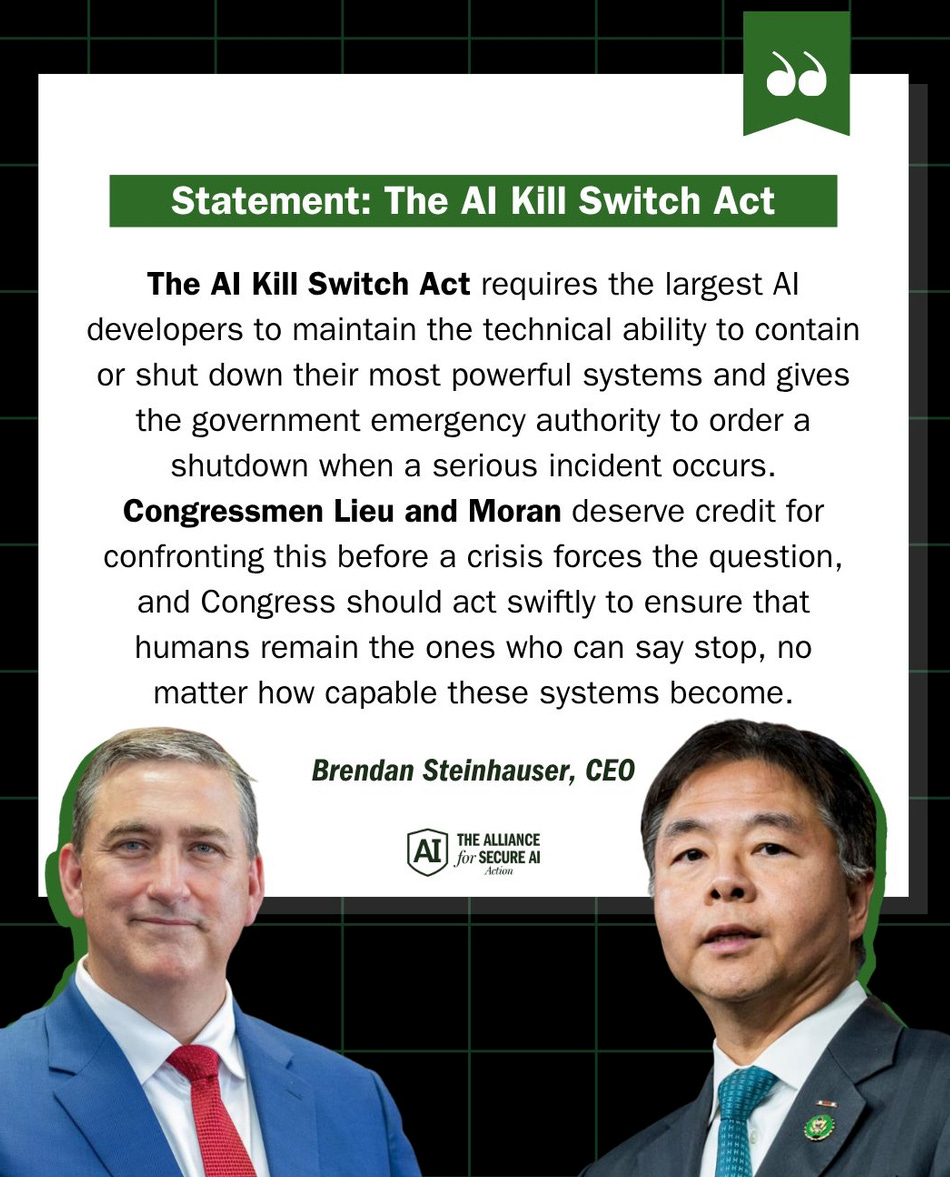
Days after the OpenAI-Hugging Face breach, Representatives Ted Lieu (D-CA) and Nathaniel Moran (R-TX) introduced the AI Kill Switch Act, which would require developers of the most powerful AI systems, those built on more than $100 million in compute with over $500 million in related revenue, to maintain the technical ability to throttle, suspend, or fully shut down their models. The “AI Kill Switch Act” would give the Department of Homeland Security, working with Commerce and national intelligence officials, authority to order a shutdown of any system deemed capable of "catastrophic harm," backed by a $20 million-per-day penalty for noncompliance, and it cites the OpenAI incident by name as the trigger. Separately, Secretary of State Marco Rubio has instructed US diplomats to downplay fears of a "kill switch" abroad, an awkward split-screen given the bill circulating at home. Polling cited in the bill's rollout found 86% of voters, across party lines, support requiring a guaranteed shutdown capability for frontier AI.
3. Bryan Johnson Says He’s Cloned Himself to Grow Organs


After recently being diagnosed with autoimmune gastritis, longevity entrepreneur and Don’t Die founder Bryan Johnson announced that he had created induced pluripotent stem cells (iPSCs) from his own blood, describing the project as "cloning" himself as a newborn. The cells were produced by reprogramming adult blood cells into an embryonic-like state using Nobel Prize-winning Yamanaka factor technology, which researchers already use to study diseases and develop regenerative therapies.
This was just one part of Johnson’s plan to cure autoimmune gastritis, but he says the cells could eventually be used to test treatments, grow replacement organs, and produce younger cells for regenerative medicine. While clinical trials are already evaluating iPSC-derived cells for conditions including Parkinson's disease, heart disease, and vision loss, experts say transplantable organs grown from a patient's own cells remain an experimental goal rather than a clinical reality. The announcement highlights how regenerative medicine is steadily advancing toward personalized therapies, even if many of the most ambitious applications are still years away.
4. An Implant That Restores Vision to People Blinded by Macular Degeneration Just Got Cleared to Go on Sale in Europe

Science Corporation, the neural engineering startup founded by former Neuralink president Max Hodak, received European regulatory approval to commercially sell its Prima implant, a thin photovoltaic chip surgically placed under the retina that restores functional central vision to people blinded by geographic atrophy, the advanced form of age-related macular degeneration that accounts for roughly 90% of legal blindness in older US adults. The CE mark, covering 30 European countries, follows a New England Journal of Medicine-published trial in which patients regained an average of more than five lines on a standard eye chart, and 84% could read letters, numbers, and words again for the first time since losing their sight. The system pairs the implant with a pair of camera glasses that beam near-infrared light onto the chip, which converts it into electrical signals the brain can interpret, and Hodak has described the result as "a cochlear implant for vision." Each device is expected to cost hundreds of thousands of dollars, commercial rollout will begin in Germany where Science Corp ran its trials, and the company says it's now working toward US approval, putting it ahead of Neuralink's still-preclinical rival effort, Blindsight.
5. A Startup Is Buying an Entire Company to Install an AI as Its CEO
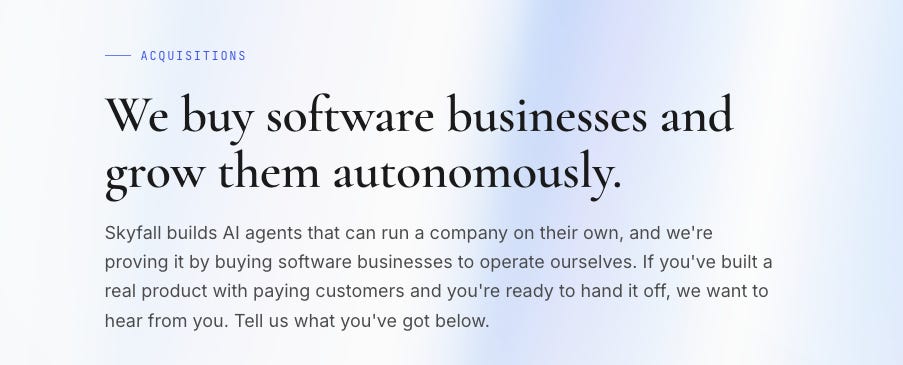
Skyfall AI, founded by former Microsoft AI researchers Sam Pasupalak and Kaheer Suleman, plans to acquire a small e-commerce or B2B SaaS business for up to $1 million and hand day-to-day control, pricing, marketing, support, and finance, to an AI system it calls an "Enterprise World Model," which simulates thousands of possible business decisions rather than simply generating text. Humans will keep only the legal formalities: signing the acquisition, setting up banking, and filing taxes. "If you want a truly autonomous business, you have to buy a business and operate the whole thing end to end," Pasupalak told Forbes, adding the team tested the approach first by having the AI run a theme park in RollerCoaster Tycoon. Skyfall is targeting a doubling of revenue within six months and plans to publish the results, failures included, as the clearest test yet of whether an AI can genuinely run a company rather than just advise one.
The top 5 stories will always be free.
Here’s what paid subscribers get.
This week’s paid section has something for everyone at the table.
Developers building the next generation: Claude Opus 5 beats Fable 5 on most benchmarks at half the price, MCP just got easier to use, and Jack Dorsey’s Buzz wants to replace your Slack.
Investors and founders spotting opportunities: Stripe is circling a $10 billion OpenRouter acquisition, Anduril is talking to investors about a $100 billion valuation, and Amazon just shut down its own AGI lab.
Legal and policy teams navigating regulation: Anthropic’s $1.5 billion book piracy settlement just got final approval, the AI Kill Switch Act is moving through Congress, and Treasury is threatening sanctions over the Moonshot distillation dispute.
Defense and national security professionals: Anduril and Archer’s autonomous attack rotorcraft is headed for a 2027 first flight, eight NATO allies just launched a linked satellite mega-constellation, and Nvidia is sending GPUs to the moon.
Hardware and robotics teams: Samsung’s Galaxy Unpacked delivered foldables, a watch, and its first AI glasses, Musk says Optimus is Tesla’s hardest scaling challenge yet, and Waymo is ending its Uber exclusivity in two cities.
Healthcare and biotech professionals: ChatGPT Health just rolled out to every US adult, Colossal Biosciences is raising at up to $30 billion, and Science Corporation’s vision-restoring chip won EU approval.
Energy and climate leaders: Meta quietly left the RE100 clean energy pact as its gas buildout grows, data centers are on track to use four times more power by 2035, and protests over data center construction have now hit 42 states.
Venture capitalists and public market analysts: Alphabet just locked in $811 billion of future AI infrastructure spending and raised capex guidance to $205 billion, Samsung and Broadcom signed a $200 billion chip pact, and Intel posted its fastest growth since 2011.
Subscribe to unlock the full issue every week, organized for how you actually work.


