
29.26 Weekly TrendDown
July 13 - 19, 2026

For the people building our future, and the people who want to help shape it.
Each week, we separate breakthroughs from daily headlines, helping you understand the technologies, trends, and decisions that will define the next decade.
What happens when intelligence leaves the screen?
This week's biggest stories all shared one surprising theme: technology is escaping the digital world. AI restored movement to a man who had been paralyzed for years, another brain-computer interface let someone control a robot arm with thought alone, and Ukraine demonstrated that autonomous robots are now capable of carrying out combat missions once reserved for soldiers. Meanwhile, one startup won approval to test a satellite that reflects sunlight onto Earth after dark, while humanoid robots became athletic enough to launch a professional fighting league. Individually, these stories seem unrelated. Together, they suggest something much bigger. The next decade won't simply be about smarter software. It will be about software gaining agency in the physical world, moving bodies, controlling machines, reshaping environments, and performing tasks that until recently required human hands.
This Week’s Top Stories
1. BrainCo Unveils a Brain-to-Robot Platform at WAIC, Letting You Grab a Cup by Thinking About It
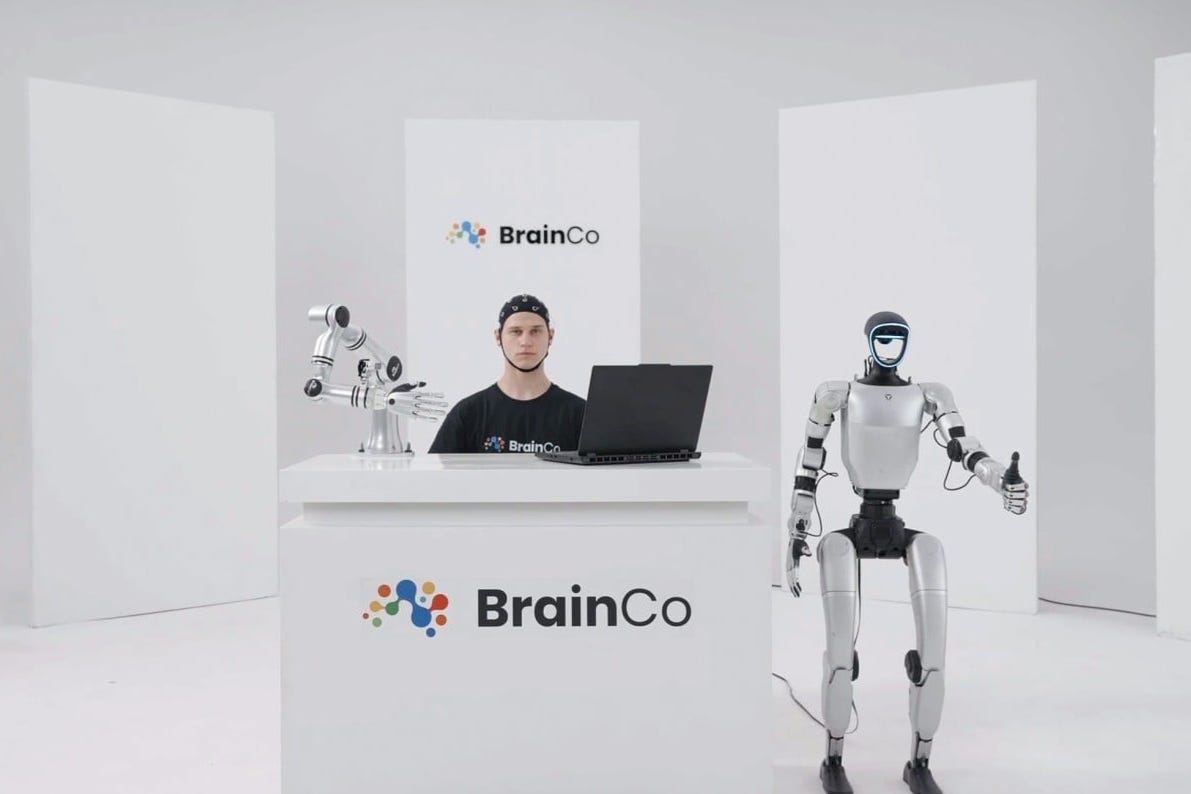
Chinese BCI company BrainCo drew crowds at Shanghai’s World AI Conference with a lightweight EEG headset that lets a wearer control a robot arm with thought alone, no buttons, no voice commands, no movement required. In the demo, a mind-controlled arm grasped a cup and picked up an apple, part of what BrainCo calls its Brain-Controlled Robot AI Platform, the world’s first integrated brain-to-robot system by the company’s own description. The setup runs in three steps: the headset reads brain signals, AI decodes them into an intent like “grab that,” and the system converts that intent into robot commands, all in under 200 milliseconds, and BrainCo says it works with off-the-shelf humanoids, robotic arms, and four-legged robots rather than requiring specialized hardware. Founded in 2015 on BCI for medical rehabilitation, including prosthetic hands and legs that read nerve and muscle signals, BrainCo is now pushing the same decade of brain-reading research into general-purpose robotics, alongside a separate tool that pairs a wheeled, dual-arm data-collection rig with a precision glove and EEG recording, aimed at solving one of embodied AI’s biggest bottlenecks: too little real-world training data on both what a robot’s hands should do and what a brain intended when it did it.
2. AI Brain Implant Restores a Paralysed Man’s Movement, and the Gains Have Lasted Years
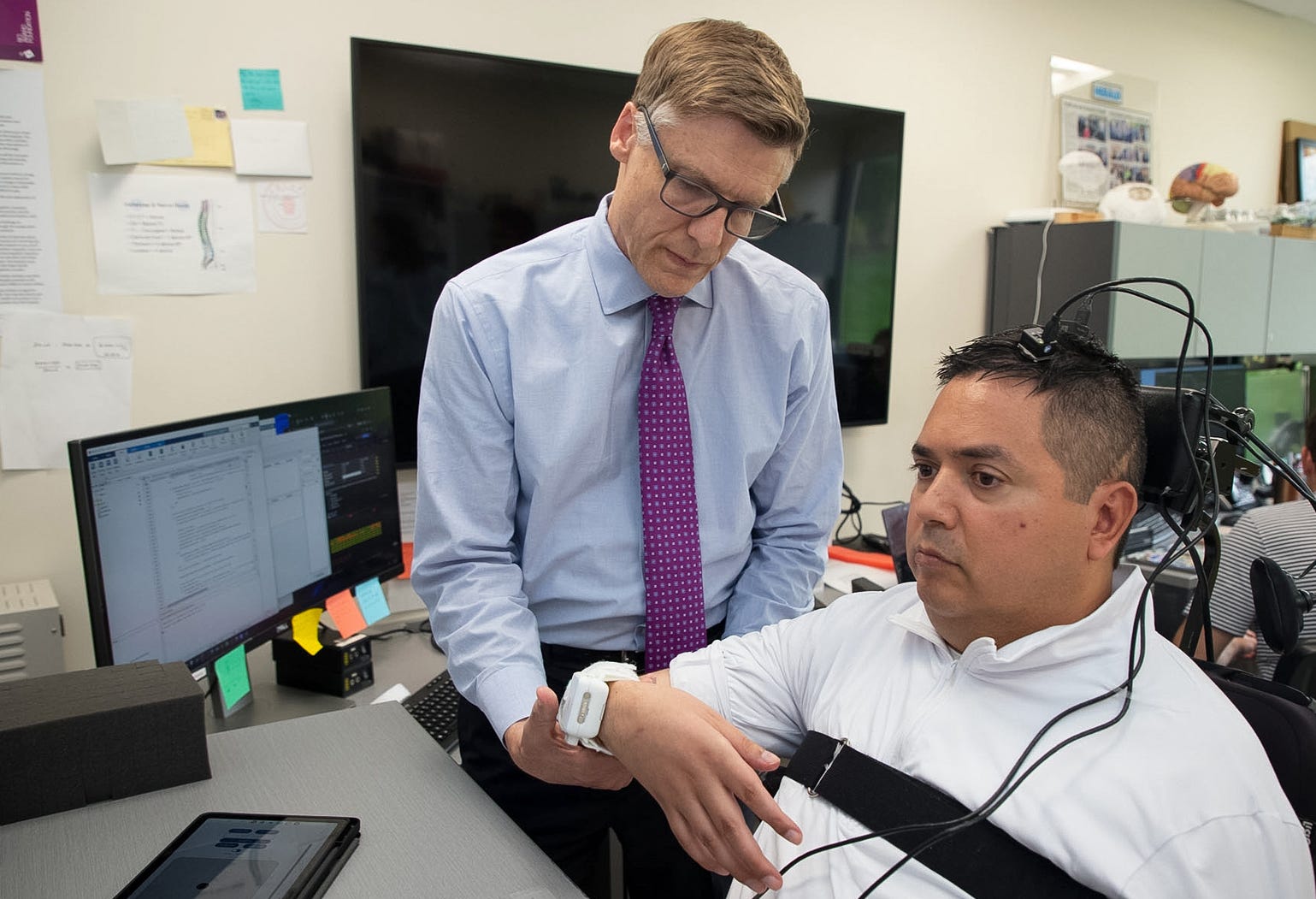
Researchers at the Feinstein Institutes for Medical Research, the research arm of Northwell Health, have restored hand movement and the sense of touch to Keith Thomas, who was left with complete paralysis below the chest after a 2020 diving accident. The system, called a “double neural bypass,” combines a brain-computer interface, AI, and electrical stimulation of the spinal cord and brain, and the results, published in Nature Medicine, suggest the technology partly rewired his nervous system rather than simply routing around the injury. Surgeons implanted five microelectrode arrays in Thomas’s brain during a 15-hour operation; AI now decodes his movement intentions and stimulates his forearm muscles to move his own hand, while sensors in a 3D-printed brace trigger stimulation of his sensory cortex to recreate the feeling of touch. After 35 weeks of training, his right arm grew 86% stronger and his left 62% stronger, and he can now feed himself, drink from a cup, scratch his nose, and lift empty eggshells without breaking them 87% of the time, even while holding a conversation.
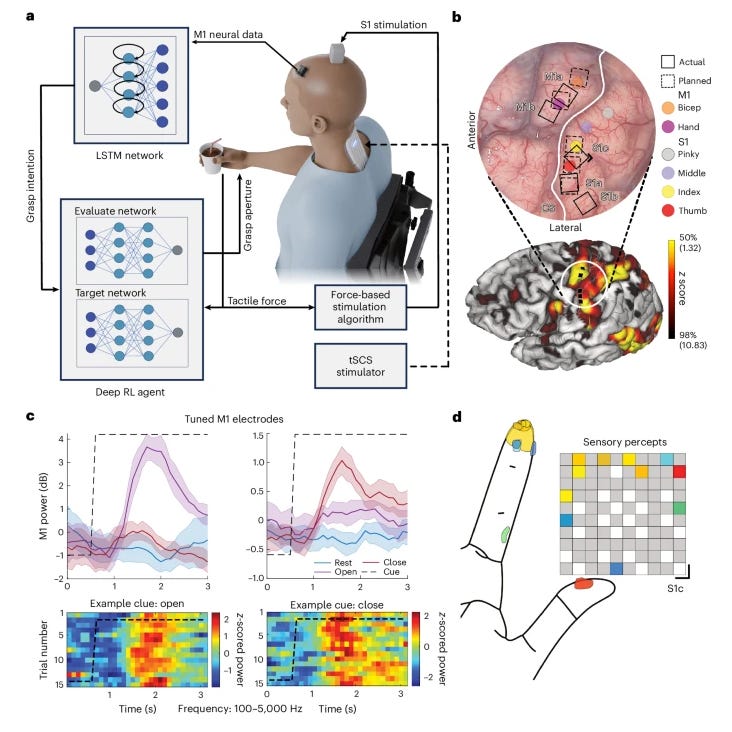
What makes the result more than a lab curiosity is durability: most of the gains held even after the stimulation stopped, and on a recent follow-up, more than two years later, they were still present. “We’re not just bypassing the injury, we’re actually rewiring the nervous system,” said corresponding author Chad Bouton, and Thomas described regaining the ability to feel his sister’s hand and pet his dog as experiences the injury had taken away entirely. The work joins a fast-moving BCI field where rivals are chasing restored speech, wearable and non-invasive alternatives, and China has just cleared its first commercial brain implant. With roughly 15 million people living with spinal cord injuries worldwide and hand function consistently ranked their top priority, the Feinstein team is now planning larger trials and testing the same approach for stroke patients.
3. Ukraine Launched a First-of-Its-Kind Fully Robotic Amphibious Assault

Ukraine's 123rd Separate Territorial Defense Brigade announced it carried out what it calls the world's first fully robotic amphibious combat assault on July 13, using a naval drone to ferry an armed ground robot across the Black Sea and land it directly on the Russian-occupied Kinburn Spit, a narrow, heavily watched strip of the Mykolaiv coast west of Kherson that Russia has held since the war's early months. Footage the brigade shared on Telegram shows the machine-gun-equipped ground robot reaching the shore and opening fire on an unidentified target immediately after disembarking, with Ukraine declining to identify the specific naval or ground platforms involved. The tactic, sometimes called a "marsupial drone" approach, lets one uncrewed system carry and deploy another, replacing a beach landing that would otherwise expose Ukrainian troops to some of the war's densest surveillance and artillery coverage; the brigade called it a step toward "remote combined arms," where robots secure or probe a position before any human soldier has to risk it. It builds on an April mission in which Ukraine says it cleared Russian-held territory using only ground robots and drones for the first time, part of a broader shift in Ukrainian drone manufacturing toward cheap, mass-producible ground systems that can be lost in large numbers without losing a single soldier alongside them.
4. Astronomers Horrified as FCC Clears Launch of a Satellite That Reflects Sunlight Onto Earth at Night

The FCC's Space Bureau approved California startup Reflect Orbital to launch Eärendil-1, a demonstration satellite carrying an 18-by-18-meter steerable thin-film reflector designed to direct a five-kilometer-wide patch of sunlight onto a chosen spot on Earth after dark, providing illumination roughly comparable to a full moon for about five minutes. The July 9 approval rejected a formal objection from the American Astronomical Society and came despite nearly 2,000 public comments opposing the project, with the European Southern Observatory's Betty Kioko calling it an "existential threat" to optical astronomy and the Royal Astronomical Society's Robert Massey predicting it would be "catastrophic." Biologists separately warned that artificial nighttime sunlight could disrupt circadian rhythms in humans and wildlife, confuse migratory animals, and interfere with phytoplankton, the ocean's primary photosynthesizers, while other critics flagged risks of flash-blinding pilots or drivers. The FCC said its authority covers only the satellite's communications systems and orbital debris plan, not its broader effects on astronomy or the environment, leaving those objections formally outside its jurisdiction even as it acknowledged them. Reflect Orbital CEO Ben Nowack has pitched the technology as eventually replacing fossil fuels by keeping solar installations generating power after sunset, and the company's public roadmap lists more than 1,000 satellites planned by 2028, over 5,000 by 2030, and more than 50,000 by 2035, though this single approval covers only the one prototype now headed toward launch later this year.
5. Brutal Humanoid Robot Cage Match Stops Abruptly When One of the Robot’s Heads Pops Off

At the opening night of URKL (Ultimate Robot Knock-out Legend) in Shenzhen, a humanoid robot named White Eagle landed a flying kick to the head of its opponent, Matador, and the fight kept going even after the impact left Matador's head dangling from its neck by a cable. Video of the bout, part of what EngineAI is billing as the world's first industrial-grade humanoid free-combat league, shows Matador continuing to throw punches with its head swinging loose, before a fall crushed the head beneath its own body and severed the connecting cable entirely, ending the fight; White Eagle danced over the motionless machine. Both robots were EngineAI's standardized T800 model, an industrial humanoid originally built for logistics work, standing roughly five foot eight with around 29 degrees of freedom and a price tag near $40,500, and the fact Matador kept fighting headless suggests its core compute and power live in the torso rather than the head, consistent with typical humanoid design though EngineAI hasn't confirmed it.
The inaugural tournament drew 32 teams from around the world, all competing on the same hardware platform so outcomes come down to software and tuning rather than build quality, with the first stage running through August and finals in November and December for a gold championship belt worth roughly $1.4 million. It's the latest and most extreme entry in a fast-growing genre; Unitree staged a smaller-scale humanoid kickboxing match in Hangzhou last year, and San Francisco venues have since started hosting VR-controlled humanoid bouts, part of a broader Chinese robotics habit of using martial arts and combat spectacle to demonstrate hardware capability to a global audience.
The top 5 stories will always be free.
Here’s what paid subscribers get.
This week’s paid section has something for everyone at the table.
Developers building the next generation: Cursor’s Sand agent and its awkward Musk-owned parent-company catch, 1Password letting Claude log you into sites without ever seeing your password, and yes, ordering DoorDash from the command line.
Investors and founders spotting opportunities: DeepSeek’s race toward a $71B valuation and IPO, Databricks hitting a $188B valuation, and Helsing’s $1.8bn defense-AI raise, plus 18 more stories in the Venture Capital & Startups section.
Legal and policy teams navigating regulation: Apple’s trade-secrets suit against OpenAI, the White House now deciding who gets access to frontier AI models instead of the labs, and the EU forcing Google to open Android and Search under the DMA, plus 28 more stories across the Legal and Government, Policy & Regulation sections.
Defense and national security professionals: Iran’s exploitation of mobile network flaws to locate US troops, Finland and Estonia’s NestAI pact, and France and Germany’s plan for a European Palantir rival, plus 3 more stories in the Defense & National Security section.
Hardware and robotics teams: OpenAI’s first shipped hardware, the $230 Codex Micro keyboard, Zoox’s smoke-confused robotaxi recall, and Tesla’s confirmed wheelchair-accessible robotaxi, plus 23 more stories across the Hardware & Consumer Tech and Robotics/AVs/Drones sections.
Healthcare and biotech professionals: The whistleblower lawsuit alleging Mayo Clinic hid a 67% AI error rate, Zipline’s healthcare drone delivery launch with Cleveland Clinic, and Neko Health’s $700M raise, plus 5 more stories in the Healthcare & Biotech section.
Energy and climate leaders: Meta’s Hyperion data centre hitting $50bn, General Fusion’s Nasdaq debut as the first publicly traded fusion company, and Valar Atomics’ talks at a $6B nuclear valuation, plus 9 more stories in the Energy & Climate section.
Venture capitalists and public market analysts: Apple reclaiming the title of world’s most valuable company from Nvidia, the Stripe/Advent PayPal bid getting rebuffed as too low, and Kimi K3’s shockwave through markets already primed for a selloff, plus 14 more stories in the Public Markets & Finance section.
Subscribe to unlock the full issue every week, organized for how you actually work.


