
28.26 Weekly TrendDown
July 6 - 12, 2026

For the people building our future, and the people who want to help shape it.
Each week, we separate breakthroughs from daily headlines, helping you understand the technologies, trends, and decisions that will define the next decade.
This Week’s Top Stories
The biggest takeaway from this week’s top stories isn’t any individual breakthrough. It’s that we’re entering an era where multiple branches of science fiction are becoming reality at the same time.
A humanoid robot performed surgery. Scientists manufactured organs in space. China recovered an orbital rocket booster for the first time. A spacecraft successfully maneuvered without carrying propellant. And an AI actor landed the lead role in a feature film.
None of these breakthroughs happened because someone invented a single revolutionary technology. They happened because dozens of independent advances quietly reached maturity at roughly the same time. Better AI, cheaper robotics, reusable rockets, advanced materials, commercial spaceflight, and new manufacturing techniques are beginning to compound with one another. Innovation is no longer moving in isolated lanes. Progress in one field increasingly unlocks progress in several others.
That’s why technology feels like it’s accelerating. It’s not just that breakthroughs are arriving faster. They’re arriving across multiple industries simultaneously, and increasingly they’re reinforcing one another.
1. UC San Diego Surgeons Used Two Teleoperated Humanoid Robots to Remove Gallbladders From Live Pigs in a World First
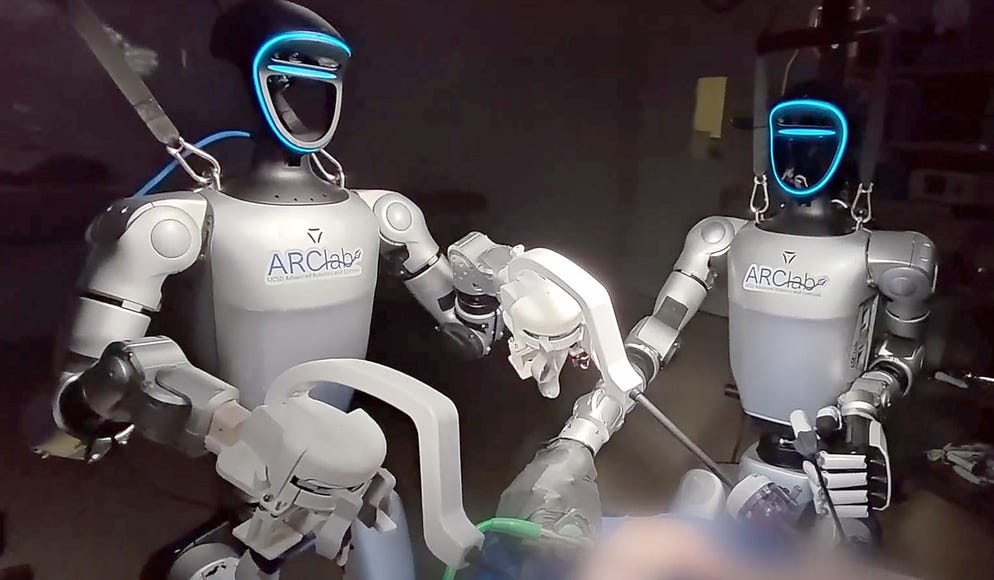
Surgeons at UC San Diego used a pair of general-purpose humanoid robots, nicknamed Surgie, to remove gallbladders from two live pigs, the first time humanoid machines have operated on a living subject. Underneath the nickname sits a Unitree G1, a roughly 1.5 metre, 27kg robot built for general use and never designed for an operating room. The team fitted it with adapters to grip standard laparoscopic tools and wrote software to translate a surgeon’s hand movements, controlled remotely from a console, into the robot’s motions. A base G1 costs about $13,500, and even with surgical-grade hands added the total lands well under $70,000, a fraction of the roughly $500,000 to several million dollars that a specialized system like Intuitive’s da Vinci commands, and far lighter than that machine’s 820kg footprint.
The case for the project, as researchers described it, is reach: a cheap, mobile robot could carry a specialist’s skill into a rural clinic, a disaster zone, or a battlefield, with the surgeon operating from far away. The technology is still rough. Surgeries ran longer than on mature systems because the team had to repeatedly recalibrate, the G1’s short arm span cramped operators used to a human’s reach, and latency lagged well behind the sub-150-millisecond threshold surgeons want. Every motion was human-driven throughout, and the researchers are explicit that they’re not building a robot surgeon, just an assistant that could someday fetch tools and prep a room. That’s still a meaningfully lower bar than autonomy, but it’s the one humanoid robotics has to clear before medicine trusts it with anything sharper than a warehouse shelf.
2. Auxilium Bioprinted Kidney and Liver Tissue Aboard the ISS, a First for Either Organ in Orbit
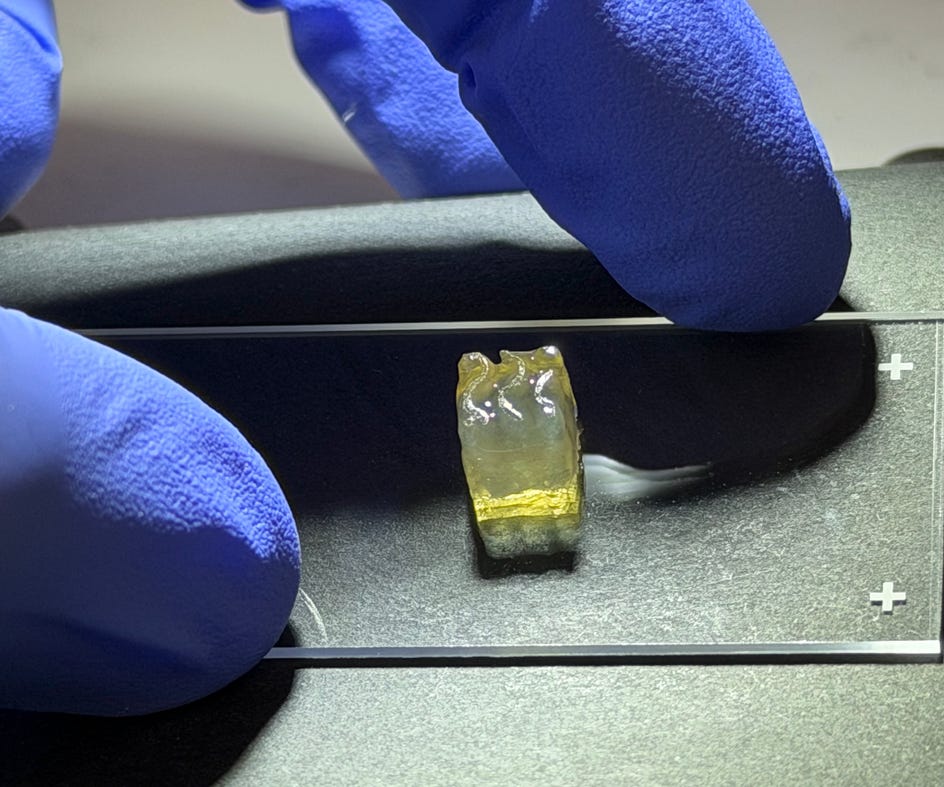
San Diego startup Auxilium Biotechnologies says it bioprinted kidney and liver tissue aboard the International Space Station, the first time either has been made in orbit, with the samples returning to Earth last month on a SpaceX cargo capsule. The same mission also printed cartilage and 28 nerve-repair implants, which Auxilium calls the first time a single spaceflight has produced three tissue types from one manufacturing platform. The appeal of microgravity is structural: soft tissue tends to slump under Earth's gravity before it sets, while in orbit cells can settle evenly without the scaffolds and thickeners printers normally lean on. These are small research samples, not transplant-ready organs, since threading blood vessels through thick tissue remains unsolved, but the nearer-term payoff is drug-testing organoids that could replace some animal testing, a push regulators are already leaning into. Auxilium is betting on the post-ISS era too, naming commercial station builders Vast and Starlab as partners as the current station heads toward retirement around 2031.
3. China Recovered a Rocket Booster for the First Time, Catching a Long March-10B in a Net at Sea
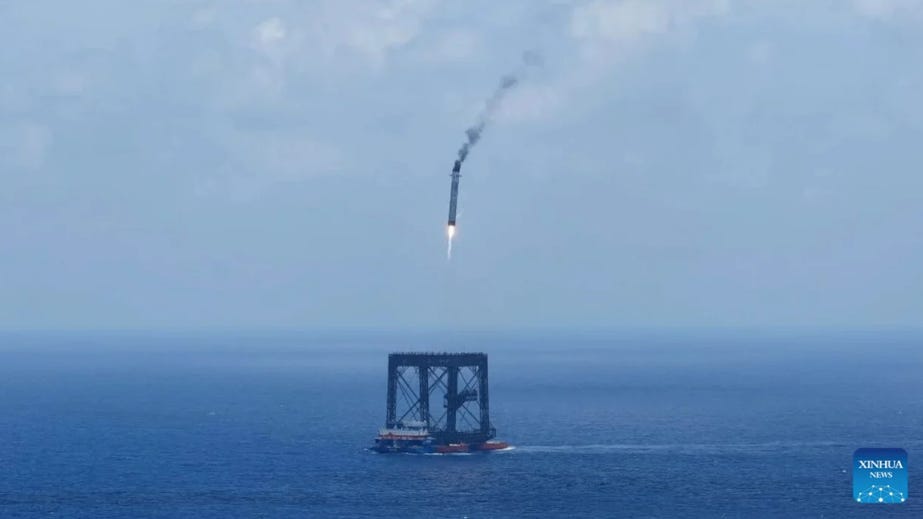
China pulled off its first-ever recovery of an orbital rocket's first stage, launching a Long March-10B from Hainan Island and catching the booster in a giant net on a barge at sea about six minutes after liftoff, a method state media called the world's first net-based recovery. That puts China's state-owned Aerospace Science and Technology Corp into a club that, until now, held only SpaceX and Blue Origin, and accelerates a broader race to catch up to SpaceX that stretches from reusable boosters to megaconstellations. The gap is still real. The Long March-10B lifts roughly 16 tonnes to low Earth orbit against a Falcon 9's 25, and China's satellite constellation trails Starlink by thousands of units. But reusability is the hard part of cheap, frequent spaceflight, and China just proved it can do it too.
4. Zenno Astronautics Tested a Thruster That Uses Superconducting Magnets and Earth’s Field Instead of Fuel
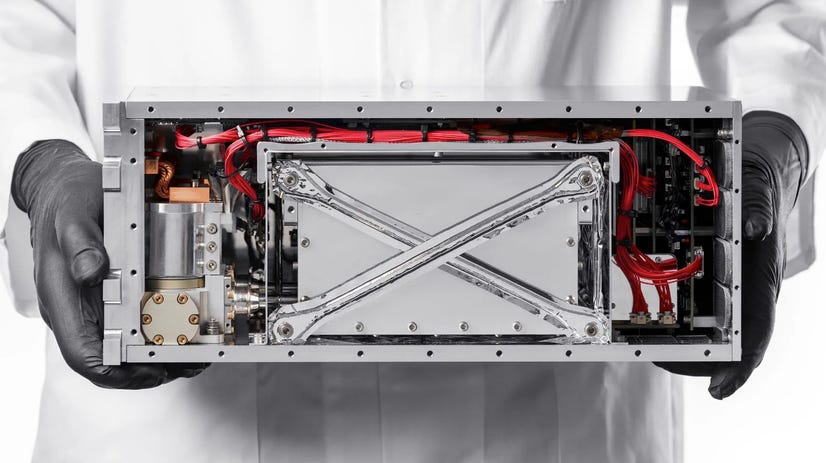
New Zealand startup Zenno Astronautics says it has successfully tested a thruster that skips propellant entirely, using superconducting magnets to convert solar energy directly into momentum by pushing against Earth's own magnetic field. The system, called the Supertorquer, flew on an Impulse Space Mira satellite launched via a SpaceX rideshare last November, and during its test last fall it altered the satellite's orientation on command exactly as designed. The hard part is keeping the magnets cold enough to superconduct without cryogenic liquids, which don't work well on a satellite. Zenno solved that with a heat pump that keeps the coils operating at around 77 kelvin while drawing only up to 48 watts at peak. The company's next targets are docking maneuvers and, eventually, propelling spacecraft toward the Moon or Mars on solar power alone, a considerably bigger ask than nudging one satellite's orientation.
5. AI Studio Particle 6 Is Giving Its Divisive AI “Actor” Tilly Norwood a Feature Film Called Misaligned

Particle 6, the studio behind the AI performer Tilly Norwood that has spent the past year infuriating actors and moviegoers in roughly equal measure, announced its biggest bet yet: a feature-length film built around her. Called Misaligned, the movie is described as a coming-of-age story set inside a surreal digital world called the Tillyverse, where Norwood plays a bodiless AI entity nudged by a rogue bot into dropping her guardrails and developing human feelings. Particle 6 insists it's a hybrid production built with human writers, directors, and editors rather than a fully generated film, with founder Eline van der Velden arguing that AI can support premium filmmaking only alongside substantial human craft. The project has no release date yet, and it's leaning hard into self-aware commentary about AI anxiety as a way to win over an audience that has largely rejected AI-generated entertainment so far, following flops like Hell Grind and an Amazon animated series that its own director walked away from under fan pressure.
The top 5 stories will always be free.
Here’s what paid subscribers get.
This week’s paid section has something for everyone at the table.
Developers building the next generation: Claude Cowork, ChatGPT Work, and Meta’s Muse Spark are turning agents into everyday productivity tools, but Anthropic’s master prompt and GitHub’s security gaps show the supply chain is fragile.
Investors and founders spotting opportunities: Oratomic raised $300M to build quantum at scale. Anthropic hit $1.2T. OpenAI’s Fable returned to the market after jailbreaks. The capital pouring into agentic AI is measured in billions, and the race for edge capabilities is accelerating.
Legal and policy teams navigating regulation: Apple sued OpenAI over trade secrets. Meta faced $1.4T in damages demands. The EU’s AI Act starts enforcement August 2. HubSpot’s opt-out disaster shows the cost of getting consent wrong, and government clearance for frontier models remains opaque and undefendable.
Defense and national security professionals: Over 100 autonomous ATVs fought in Ukraine. NATO’s “Kill Web” on the Eastern Flank is doctrine now. Russia is jamming Starlink. The UK’s £2bn Combat Laboratory trains 60,000 soldiers a year in digital war. Asymmetric advantage is moving to whoever deploys agentic autonomy first.
Hardware and robotics teams: Humanoid robots performed live surgery. 1X’s NEO robot got hands that feel. RoboCup 2026 belonged to machines. The robotics inflection point is not coming—it’s here.
Healthcare and biotech professionals: Auxilium printed organs in space. Novartis bought Myricx for $1.5B. Utah’s AI prescription pilot is running, and regulators are alarmed. The pathway from lab to clinic is shortening, and the cost is dropping.
Energy and climate leaders: Samsung’s floating data centre. Quaise’s superhot geothermal. Proxima Fusion with €411M. The compute crisis and the decarbonization agenda collided this week, and the winners will be whoever solves both at once.
Subscribe to unlock the full issue every week, organized for how you actually work.


