
27.26 Weekly TrendDown
June 29 - July 5, 2026

This Week’s Top Stories
Physical autonomy and AI governance moved in lockstep this week. Tesla stripping the steering wheel out of a production vehicle and Anthropic getting its most capable models un-banned signal that regulators are actively rewriting the rules around AI systems taking real-world action, not just answering questions. Meanwhile the NHS, Meta, and Rome stories all point to the same quieter trend: AI is being pointed at bodies now, triaging patients, reading thoughts through skin and bone, and watching over vulnerable people. The throughline is that AI is moving from chat windows into cars, clinics, and skulls, which raises the stakes on every safety and governance question by an order of magnitude.
For the people building our future, and the people who want to help shape it.
Each week, we separate breakthroughs from daily headlines, helping you understand the technologies, trends, and decisions that will define the next decade.
1. Tesla Puts a Production Cybercab With No Steering Wheel or Pedals on Austin Public Roads for the First Time

Tesla posted video this week of a gold, two-seat production Cybercab driving itself through Austin traffic with zero manual controls inside. A safety monitor rides in the right seat but has nothing to grab if things go wrong, the first time Tesla has put a control-free vehicle on public roads after weeks of testing prototypes that still carried steering wheels and pedals for engineering purposes. The timing lines up with regulation: NHTSA proposed dropping the federal brake-pedal requirement for vehicles designed to be driven exclusively by automated systems just the week before, and Tesla’s own First Responder Interaction Plan describes the Cybercab as SAE Level 4 autonomous, with exterior speakers, rapid hazard lights, and hand-signal recognition built in for emergency crews.
Tesla has run a Model Y-based robotaxi service in Austin since June 2025, with 42 vehicles registered in Texas against Waymo’s 577, and has logged 17 disclosed incidents since, including at least two crashes caused by remote teleoperators. Waymo has had its own stumbles, including a nearly 4,000-vehicle recall after robotaxis kept driving into highway construction zones. Tesla is targeting a retail price under $30,000 and a long-term goal of 2 million Cybercabs a year, betting that owning both the vehicle and its camera-only driving software gives it a durable cost edge over Waymo’s lidar-radar-camera stack. One question nobody’s answered yet: since Tesla plans to sell Cybercabs to individual owners rather than operate them all itself, it’s unclear how an owner would move a broken-down car that has no steering wheel to fall back on.
2. Anthropic’s Fable 5 and Mythos 5 Return After an 18-Day US Export Ban, the Same Week Anthropic Launches Claude Science and Claude Sonnet 5
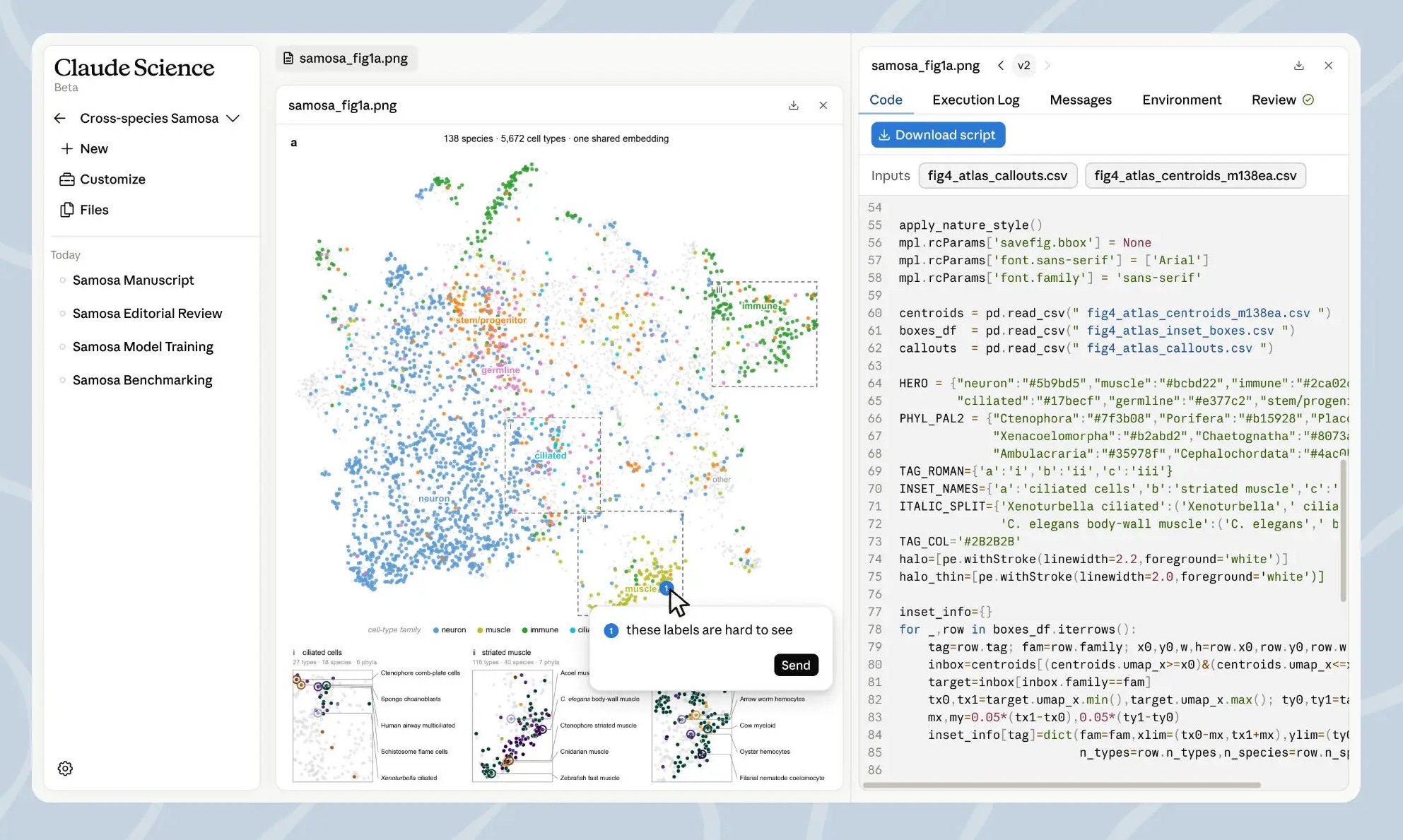
On June 12, the Commerce Department ordered Anthropic to abruptly cut off all foreign nationals, including its own foreign-national employees, from Claude Fable 5 and Mythos 5, citing national security authorities after what Anthropic described as a jailbreak demonstration involving only “a small number of previously known, minor vulnerabilities.” Commerce granted partial relief on June 26 for about 100 vetted US critical-infrastructure organizations, then on June 30 Commerce Secretary Howard Lutnick announced the controls were being withdrawn entirely, stating plainly that a license is no longer required to export, reexport, or transfer the models. Fable 5 access returned globally on July 1 across Claude.ai, Claude Code, AWS, Google Cloud, and Microsoft Foundry, with expanded usage limits offered through July 7, while Mythos 5 stays limited to vetted US partners through Anthropic’s Glasswing program for now. In exchange, Anthropic built a new safeguard it says blocks the jailbreak technique 99% of the time and agreed to flag malicious activity to the government, though Lutnick’s letter reserves the right to reimpose controls if circumstances change.
The same week, Anthropic shipped two new products. Claude Science is a new beta desktop app, not a new model, that unifies the scattered tools researchers currently juggle (PubMed, Jupyter, R, cluster terminals) into one workspace connected to 60+ scientific databases, with every output shipping a reproducibility package and a dedicated reviewer agent auditing citations before publication. Early users reported real gains: an Allen Institute researcher cut literature-review production from up to two years down to about 10 agent-verified reviews, and a UCSF researcher got comprehensive glioma analysis down to roughly a tenth of its previous time. Separately, Claude Sonnet 5 launched as Anthropic’s new agentic mid-tier model, replacing Sonnet 4.6 as the default for Free and Pro users at introductory pricing of $2 per million input tokens and $10 per million output tokens, landing close to Opus 4.8 on reasoning and coding benchmarks for a fraction of the cost, though a new tokenizer means the real-world discount is more modest than the sticker price suggests. Anthropic’s own safety testing found Sonnet 5 safer overall than its predecessor but still weaker on cybersecurity capability than Opus 4.8 or Fable 5.
3. NHS App Adds AI Triage to Steer Patients to the Right Care, Part of a £10 Billion Tech Overhaul

A new AI triage tool in England’s NHS App asks adaptive questions based on symptoms and directs patients to a GP appointment, pharmacy, A&E, community service, or self-care, reaching 200,000 patients within a year and every NHS App user by April 2028 as part of a £10 billion, three-year technology overhaul. A trial at one Sussex GP practice already cut phone queues for same-day appointments by 29%, and NHS England’s CEO called it part of a wider push expected to deliver roughly half the government’s 10 Year Health Plan commitments. The package also funds a national rollout of ambient voice technology that listens to consultations and drafts clinical notes, which one London trial found gave clinicians about 25% more direct time with patients. Health leaders welcomed the money but pushed back hard on the framing: the Royal College of Nursing’s chief nursing officer warned against “overstated, overly optimistic assessments” of AI productivity gains and insisted a human professional must remain the one making decisions at key points, especially with a separate review of Palantir’s £330 million NHS data contract already underway.
4. Meta’s Brain2Qwerty v2 Decodes Typed Sentences From Brain Activity at 61% Word Accuracy, No Surgery Required
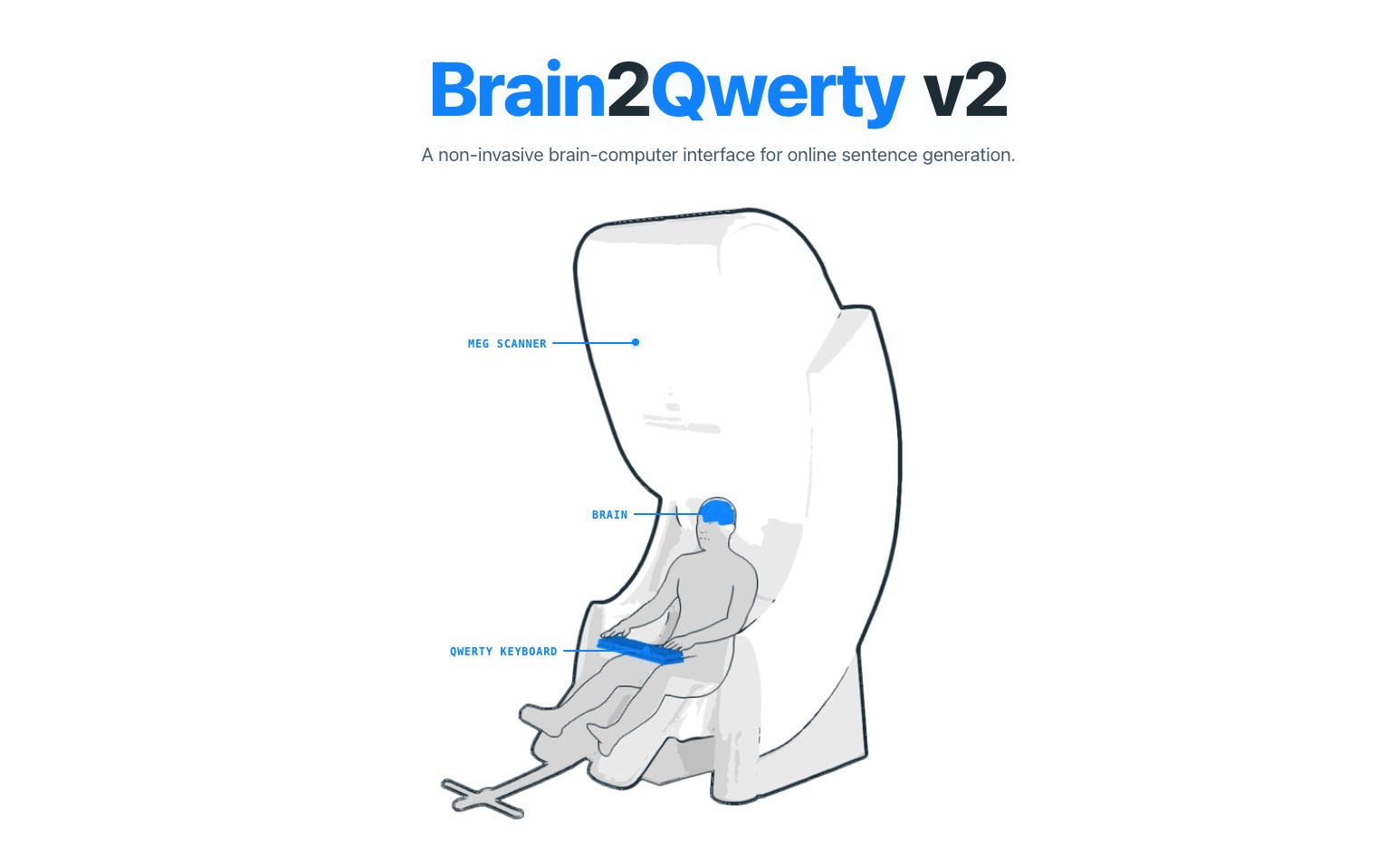
Meta FAIR’s Brain2Qwerty v2 reads magnetoencephalography signals, brain activity measured from outside the skull, while someone types, and reconstructs the sentence in real time with no implant needed, a major jump from version one, which could only decode individual keystrokes. Trained on roughly 22,000 sentences from 9 volunteers, the system reaches 61% average word accuracy across participants (up from about 8% for prior non-invasive methods), with the best participant hitting 78% and more than half their sentences decoded at one word error or less, and accuracy still scaling with more training data rather than plateauing. Meta frames the goal as restoring communication for people who lose speech after a stroke or neurological disorder without the surgical risk of implant-based systems like Neuralink, though the MEG scanners involved remain large, expensive lab equipment rather than anything close to a consumer product. Meta open-sourced the training code for both versions, and reaction has been split between enthusiasm about accessibility and distrust of an advertising company handling brain-signal data.
5. As a Deadly Heatwave Grips Europe, Rome Leans on a €400 Million Bracelet Scheme to Watch Over 700 of Its Elderly
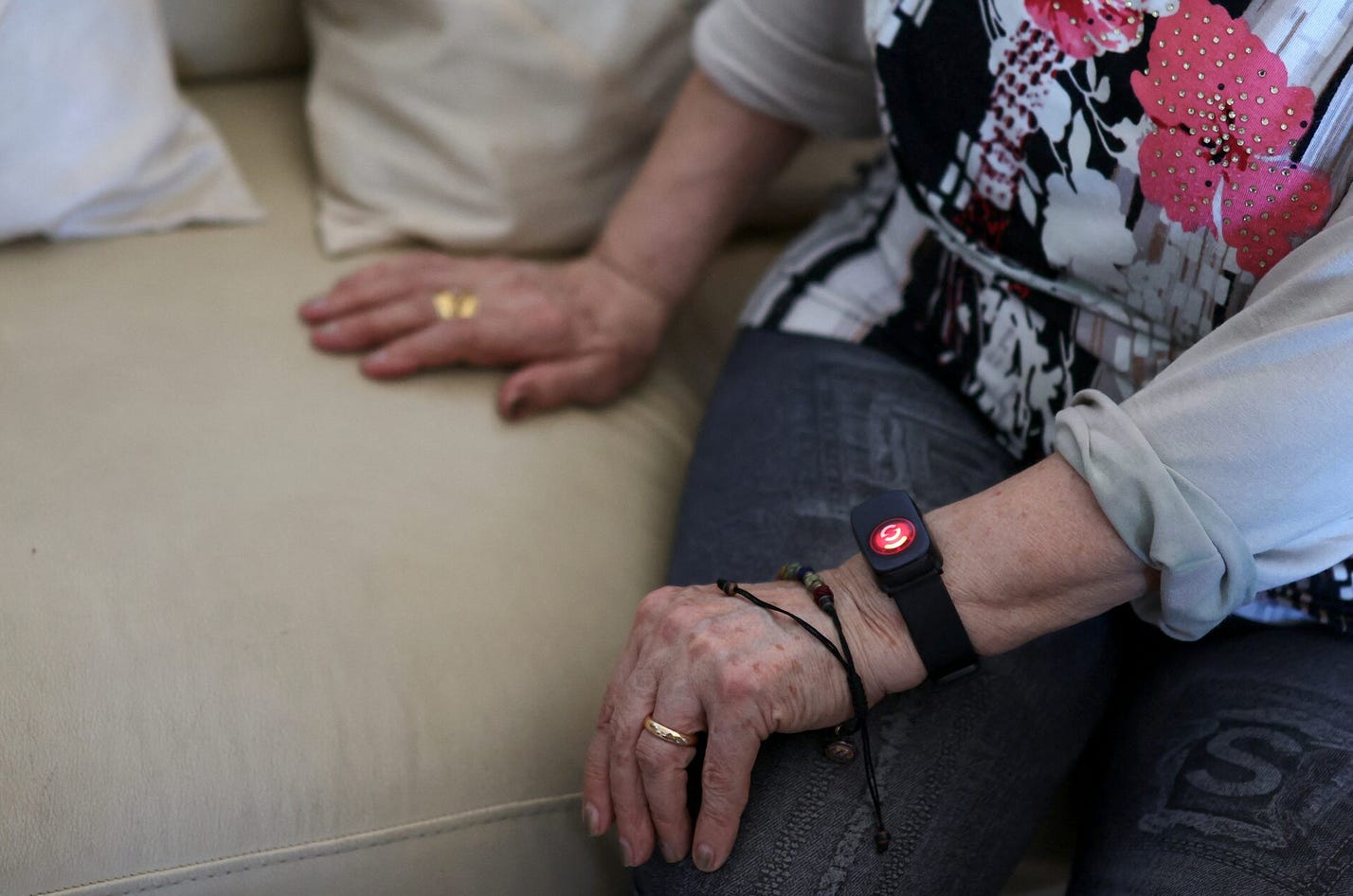
Rome’s municipality has equipped about 700 elderly residents with a wearable bracelet that tracks heart rate and sleep, detects falls, monitors movement in and outside the home, and lets the wearer call for help, with social workers checking in daily on medication and hydration. It’s part of a €400 million elderly-support scheme funded by EU post-COVID recovery money, launched as Rome spent the past week under Italy’s highest heat alert alongside 16 other cities, with emergency admissions for heat exhaustion up 10-15% nationally. The scheme’s coordinator put it plainly: “The bracelet is crucial for elderly people in this hot period, especially because their blood pressure drops, their heart rate is slightly lower than normal, they really suffer.” It hasn’t been universally embraced, only about 45 of the original 70 pharmacy enrollees have stayed in, with some dropping out over round-the-clock movement tracking, even as a World Weather Attribution study found this level of heat would have been virtually impossible without climate change.
The top 5 stories will always be free.
Here’s what paid subscribers get.
This week’s paid section has something for everyone at the table.
Developers building the next generation: Cursor shipped an iOS app developers are already using for “most” of their coding, a North Korea-linked npm supply chain attack is hunting for Claude and Cursor credentials specifically, and Alibaba just banned Claude Code companywide over a disputed backdoor claim... and 3 other stories for developers this week.
Investors and founders spotting opportunities: DeepSeek closed a record $7.4 billion round after Anthropic previewed Mythos, ElevenLabs is doubling its valuation to $22 billion in five months, and Bending Spoons priced its IPO above range to raise $1.68 billion... and 24 other stories for investors and founders this week.
Legal and policy teams navigating regulation: The Supreme Court just ruled geofence warrants need a warrant, 400 newspapers sued OpenAI and Microsoft over copyright, and Argentina’s new “non-human corporation” bill still can’t remove a human from legal liability... and 25 other stories for legal and policy teams this week.
Defense and national security professionals: Quantum Systems raised $1.2 billion for defense drones as the sector blows past last year’s funding total, and Marc Andreessen just joined the Pentagon’s board... and 2 other stories for defense and national security this week.
Hardware and robotics teams: Proception settled its Tesla trade-secret suit and shipped robot hands the same week, Weave Robotics undercut humanoid rivals with a $7,999 wheeled home robot, and SpaceX is denying a phone prototype report that moved its stock 7%... and 24 other stories for hardware and robotics teams this week.
Healthcare and biotech professionals: Scientists built a fully synthetic cell with a complete life cycle, and NIH unveiled the world’s largest genomics-health database... and 2 other stories for healthcare and biotech professionals this week.
Energy and climate leaders: South Korea committed over $900 billion to a national chip and AI buildout, and Realta Fusion generated electricity directly from a fusion reaction for what’s being called an apparent first... and 8 other stories for energy and climate leaders this week.
Venture capitalists and public market analysts: Rocket Lab bought Iridium for $8 billion to build a SpaceX-style satellite business, Momenta is going public in Hong Kong near a $9 billion valuation, and OpenAI may delay its own IPO to 2027 chasing a $1 trillion price tag... and 24 other stories for investors and analysts this week.
Subscribe to unlock the full issue every week, organized for how you actually work.


